Onion
Onion in the general sense can be used for any plant in the Genus Allium but used without qualifiers usually means Allium cepa L., also called the garden onion. more...
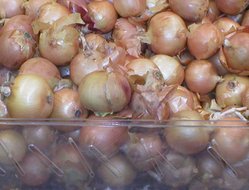
Onions (usually but not exclusively the bulbs) are edible with a distinctive strong flavour and pungent odour which is mellowed and sweetened by cooking. They generally have a papery outer skin over a fleshy, layered inner core. Used worldwide for culinary purposes, they come in a wide variety of forms and colors.
Onions may be grown from seed or very commonly from "sets". Onion sets are produced by sowing seed very thickly one year, resulting in stunted plants which produce very small bulbs. These bulbs are very easy to set out and grow into mature bulbs the following year, but they have the reputation of producing a less durable bulb than onions grown directly from seed and thinned.
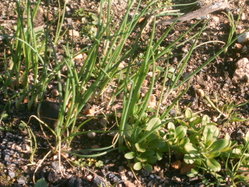
Either planting method may be used to produce spring onions or green onions, which are just onions harvested while immature, although "green onion" is also a common name for the Welsh onion, Allium fistulosum which never produces dry bulbs.
Onions are frequently used in school science laboratories because they have particularly large cells which are easily visible even through rather low-end optical microscopes. See how to prepare an onion cell slide for details.
History
It is thought that bulbs from the onion family have been utilised as a food source for millennia. In Palestinian Bronze Age settlements, traces of onion remains were found alongside fig and date stones dating back to 5000 BC. It would be pure conjecture to suggest these were cultivated onions. The archaeological and literary evidence suggests cultivation probably took place around two thousand years later in ancient Egypt. This happened alongside the cultivation of leeks and garlic and it is thought that workers who built the pyramids were fed radishes and onions.
The onion is easily grown, transportable, and has good storage qualities. Egyptians worshipped it, believing that its spherical shape and concentric rings symbolized eternal life. Onions were even used in Egyptian burials as evidenced by onion traces being found in the eye sockets of King Ramses IV. They believed that if buried with the dead, the strong scent of onions would bring breath back to the dead. The onion then made its way to Greece where athletes ate large quantities of onion because it would lighten the balance of blood. Roman gladiators were also rubbed down with onion to firm up their muscles. In the Middle Ages onions were such an important food that people would pay for their rent with onions and even give onions as gifts. Doctors were also known to prescribe onions to end headaches, snakebites and hair loss. The onion was introduced to North America by Christopher Columbus on his 1493 expedition to Haiti.
Read more at Wikipedia.org





 Contact
 Home
Home Aquatic Plants
 Plants, Seedlings
 Berries