Hydroponics
Hydroponics (from the Greek words hydro (water) and ponos (labour)) is a method of growing plants using mineral nutrient solutions instead of soil. more...
Terrestrial plants may be grown with their roots in the mineral nutrient solution only or in an inert medium, such as perlite, gravel or mineral wool. A variety of techniques exist.
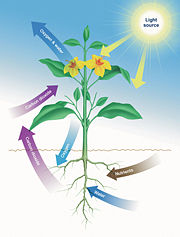
Plant physiology researchers discovered in the 19th century that plants absorb essential mineral nutrients as inorganic ions in water. In natural conditions, soil acts as a mineral nutrient reservoir but the soil itself is not essential to plant growth. When the mineral nutrients in the soil dissolve in water, plant roots are able to absorb them. When the required mineral nutrients are introduced into a plant's water supply artificially, soil is no longer required for the plant to thrive. Almost any terrestrial plant will grow with hydroponics, but some will do better than others. It is also very easy to do; the activity is often undertaken by very young children with such plants as watercress. Hydroponics is also a standard technique in biology research and teaching and a popular hobby.
History
Ancient people such as the Babylonians and Aztecs used growing techniques where nutrients were obtained from sources other than soil. The mineral nutrient solutions used today for hydroponics were not developed until the 1800s.
The earliest published work on growing terrestrial plants without soil was the 1627 book, Sylva Sylvarum by Sir Francis Bacon, although he died in 1626. Water culture became a popular research technique after that. In 1699, John Woodward published his water culture experiments with spearmint. He found that plants in less-pure water sources grew better than plants in distilled water. Mineral nutrient solutions for soilless culture of plants were first perfected in the 1860s by the German botanists, Julius von Sachs and Wilhelm Knop. Growth of terrestrial plants without soil in mineral nutrient solutions was called solution culture. It quickly became a standard research and teaching technique and is still widely used today. Solution culture is now considered a type of hydroponics where there is no inert medium.
In 1929, Professor William Frederick Gericke of the University of California at Berkeley began publicly promoting that solution culture be used for agricultural crop production. He first termed it aquaculture but later found that aquaculture was already applied to culture of aquatic organisms. Gericke created a sensation by growing tomato and other plants to a remarkable size in his backyard in mineral nutrient solutions rather than soil. By analogy with the ancient Greek term for agriculture, geoponics, the science of cultivating the earth, Gericke introduced the term hydroponics in 1937 (although he asserts that the term was suggested by Dr. W. A. Setchell, of the University of California) for the culture of plants in water (from the Greek hydros, water, and ponos, labor).
Read more at Wikipedia.org





 Contact
 Home
Home Children's Gardening Items
 Grow Light
 Grow Light