|
Flags & Flagpoles
A flag is a piece of coloured cloth flown from a pole or mast, usually for purposes of signalling or identification. Flags were initially created for signalling (as in semaphore), and for the identification of those who displayed them, and are still used for that purpose today. more...
Home
Bird & Wildlife Accessories
Fertilizer, Soil Amendments
Garden Decor
Benches
Flags & Flagpoles
American Flags
Decorative Flags
Autumn Flags
Spring Flags
Summer Flags
Winter Flags
Flag Poles
Foreign Flags
Holiday Flags
Military Flags
Fountains
Gazing Balls
Plaques & Signs
Rain Gauges
Stakes
Statuary, Yard Art
Stepping Stones, Rocks
Sundials
Thermometers
Weathervanes
Wind Chimes
Windmills
Windsocks & Devas
Garden Structures & Fencing
Hand Tools, Gear & Equipment
Outdoor Lighting
Pest & Weed Control
Planters, Pots, Window Boxes
Plants, Seeds, Bulbs
Publications
Seed Starting, Grow Lights
Flags are also used in messaging or advertising, or for decorative purposes, though at this less formal end the distinction between a flag and a simple cloth banner is blurred. Generally, a piece of cloth is a flag if it is flown like a flag, with one side attached, though many flags are recognisable if displayed in other forms.
The study of flags is known as vexillology, from the Latin vexillum meaning flag or banner.
History
Although flag-like symbols have been used by ancient cultures for thousands of years, the origin of flags in the modern sense is a matter of dispute. Some believe flags originated in China, others hold that the Roman Empire's vexillum was the first true flag.
During the Middle Ages, flags were used mainly during battles to identify individual leaders: in Europe the knights, in Japan the samurai, and in China the generals under the imperial army.
From the time of Christopher Columbus onwards, it has been customary (and later a legal requirement) for ships to carry flags designating their nationality; these flags eventually evolved into the national flags and maritime flags of today. Flags also became the preferred means of communications at sea, resulting in various systems of flag signals (see International maritime signal flags).
Beginning in the 17th century, European knights were replaced by centralized armies, and flags became the means to identify not just nationalities but also individual military units. Flags became much more elaborate, and were seen as objects to be captured or defended. Eventually these flags posed too much danger to those carrying them, and by World War I these were withdrawn from the battlefields, and have since been used only at ceremonial occasions.
National flags
One of the most popular uses of a flag is to symbolize a nation or country. Some national flags have been particularly inspirational to other nations, countries, or subnational entities in the design of their own flags. Some prominent examples include:
- The flag of Scotland, called the Saltire or St Andrew's Cross, dates to the 9th century, and is the oldest national flag still in use. Notable flags which share the saltire design include the flag of Jamaica, the Confederate Naval Jack, and the naval jack of Russia, which is also called the St Andrew's Cross. It also forms a key part in the design of the Union Flag of the United Kingdom.
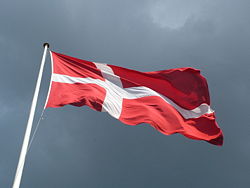
- The flag of Denmark is the oldest state flag still in use. This flag, called the Dannebrog, inspired the cross design of other Nordic countries and the flag of England. Examples: the Faroe Islands, Finland, Iceland, Norway, Sweden, Åland.
- The flag of Switzerland, with its colours reversed, gave rise to the emblem of the International Red Cross, which under international law is a safe conduct in war zones.
- The Union Flag of the United Kingdom, more commonly (and correctly, when used by warships at sea) called the Union Jack. British colonies typically flew a flag based on one of the ensigns based on this flag, and many former colonies have retained the design to acknowledge their cultural history. Examples: Australia, Fiji, New Zealand, Tuvalu, and also the Canadian provinces of Manitoba and Ontario, and the American state of Hawaii.
- The Tricolor of The Netherlands is the oldest tricolor, first appearing in 1572 as the Prince's Flag in orange-white-blue. Soon the more famous red-white-blue began appearing - it is however unknown why, though many stories are known. After 1630 the red-white-blue was the most commonly seen flag. The Dutch Tricolor has inspired many flags but most notably those of Russia and France, which spread the tricolor concept even further, as can be seen below.
- The national flag of France, also called the Tricolore, which inspired other nations to adopt differenced tricolours in sympathy with the revolutionary spirit with which the flag was designed in 1794. Examples among many: Ireland, Italy, Mexico.
- The flag of the United States, also nicknamed The Stars and Stripes or Old Glory. In the same way that nations looked to France for inspiration, many countries were also inspired by the American Revolution, which they felt was symbolized in this flag. Examples: Cuba, Chile, Liberia, Malaysia The flag of Malaysia is also referred to as Jalur Gemilang or Glorious Stripes.
- The flag of Russia, the source for the Pan-Slavic colors adopted by many Slavic states and peoples as their symbols. Examples: Slovakia, Serbia and Montenegro, Croatia, Bulgaria.
- Ethiopia was seen as a model by emerging African states of the 1950s and 1960s, as it was one of the oldest independent states in Africa. Accordingly, its flag became the source of the Pan-African colours. Examples: Togo, Senegal, Ghana, Mali.
- The flag of Turkey, which was the flag of the Ottoman Empire, has been an inspiration for the flag designs of many other Muslim nations. During the time of the Ottomans the crescent began to be associated with Islam and this is reflected on the flags of Algeria, Comoros, Malaysia, Mauritania, Pakistan, and Tunisia
- The Pan-Arab colors, green, white, red, and black, seen on the flags of Jordan, Kuwait, Sudan, Syria, the United Arab Emirates, Western Sahara, Yemen and on the Palestinian flag.
- The Soviet flag, with its golden symbols of the proletariat on a red field, was an inspiration to flags of other communist states, such as East Germany, People's Republic of China, Vietnam, Angola, Afghanistan and Mozambique.
- The flag of Venezuela, created by Francisco de Miranda to represent the independence movement in Venezuela that later gave birth to the "Gran Colombia", inspired the individual flags of Colombia, Ecuador, and Bolivia, all sharing three bands of color, and three of them (Colombia, Ecuador, and Venezuela) sharing the yellow, blue, and red.
- The flag of Argentina, created by Manuel Belgrano during the war of independence, was the inspiration for the United Provinces of Central America's flag, which in turn was the origin for the flags of Guatemala, El Salvador, Honduras, and Nicaragua.
Read more at Wikipedia.org
• [List your site here Free!]
|
|