Houseplants
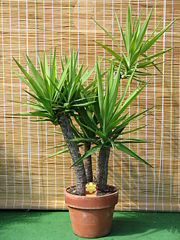
A houseplant is a plant that is grown indoors in places such as residences and offices. Houseplants are commonly grown for decorative purposes and health reasons such as indoor air purification. Plants used in this fashion are most commonly, though not always, tropical or semi-tropical. more...
Caring for a houseplant
Major factors that should be considered when caring for houseplants are moisture, light, soil mixture, temperature, humidity, fertilizers, potting, and pest control. The following includes some general guidelines for houseplant care. For specific houseplant needs, the tags that sometimes come with plants are notoriously unhelpful and generic. Specific care information may be found widely online and in books.
Moisture
Both under-watering and over-watering can be detrimental to a houseplant. The best way to determine whether a plant needs water is to check the soil moisture. Feeling the soil is most reliable, since moisture meters are often inaccurate. Most potted plants must be allowed to reach an appropriate level of dryness in between waterings, though the amount of watering required varies greatly depending on the species. Proper soil moisture can range from still slightly moist on the soil surface to very dry to nearly the bottom of the pot. Watering a plant by the calendar is not recommended. If a plant does need to be watered, water should be slowly poured over the surface of the soil until it begins to drain out the bottom of the pot, ensuring complete saturation. However, sometimes the soil separates from the sides of the pot if it is allowed to dry out thoroughly, allowing the water to flow down the sides of the rootball and out the bottom too quickly to be absorbed and retained by the soil and roots. If this is the case, it may be necessary to set the plant in a shallow dish of water long enough for it to soak up enough water to moisten the rootball to its center. Repotting should eliminate this problem. Repotting should be done only when necessary, since the roots of a plant that is in an excessively large pot may rot.
Light
Through the process of photosynthesis, plants convert the energy in sunlight to chemical energy, which fuels plant growth. The two important factors for providing light to a house plant are intensity and duration.
Different plants require different light intensities. Intensity (or quality) of light is difficult to measure without a light meter. It is usually measured in units of lux. 100 lux or less is usually considered "low intensity" or "indirect" lighting. A bright office has about 400 lux of illumination. 1,000 lux or more is usually considered "high intensity" lighting. Direct outdoor sunlight is in the range 32,000-100,000 lux. Foot-candles are also occasionally used.
Read more at Wikipedia.org



 Contact
 Home
Home Children's Gardening Items
 Aquatic Plants
 Plants